We live in a world where beauty trends change faster than the seasons. Scroll through any social media feed and you will find countless tutorials on perfectly arched brows, voluminous lashes, and pillowy lips. For many women - and increasingly men - these treatments have become routine. Normal, even. But for a Muslim who genuinely wants to please Allah ﷻ, the question is never simply "does it look good?" The real question is always "is this pleasing to my Creator?"
Here, we believe informed Muslims make better choices. This blog is not here to judge anyone. It is here to lay out, clearly and honestly, what the Quran and the authentic Sunnah of our beloved Prophet Muhammad ﷺ say about some of the most popular aesthetic treatments today; eyebrow shaping, eyelash extensions, and lip fillers.
Read with an open heart. May Allah ﷻ grant us all clarity and guidance.
THE FOUNDATION:
CHANGING THE CREATION OF ALLAH ﷻ
Before addressing individual treatments, we must understand the core Islamic principle that underpins all of these discussions.
Allah ﷻ says in the Quran:
"Indeed, Allah does not forgive association with Him, but He forgives what is less than that for whom He wills. And whoever associates others with Allah has certainly gone far astray. They call upon instead of Him none but female deities, and they call upon none but a rebellious Shaytan. Whom Allah has cursed. For he had said: I will surely take from among Your servants a specific portion. And I will mislead them, and I will arouse in them [sinful] desires, and I will command them so they will slit the ears of cattle, and I will command them so they will change the creation of Allah." — Surah An-Nisa, 4:116-119
This verse is profound. It is Iblees himself speaking, and one of his greatest tools is convincing human beings to alter what Allah ﷻ has created. The scholars of tafsir, including Ibn Kathir (rahimahullah), explain that this verse establishes a foundational principle: deliberately and permanently altering the natural form Allah gave us - out of dissatisfaction or vanity falls under what Shaytan promised to lead people towards.
This does not mean all grooming is forbidden. Islam is a balanced, practical Deen. The distinction lies between permissible grooming and altering the creation of Allah ﷻ and the hadith of our Prophet ﷺ draw that line with remarkable clarity.
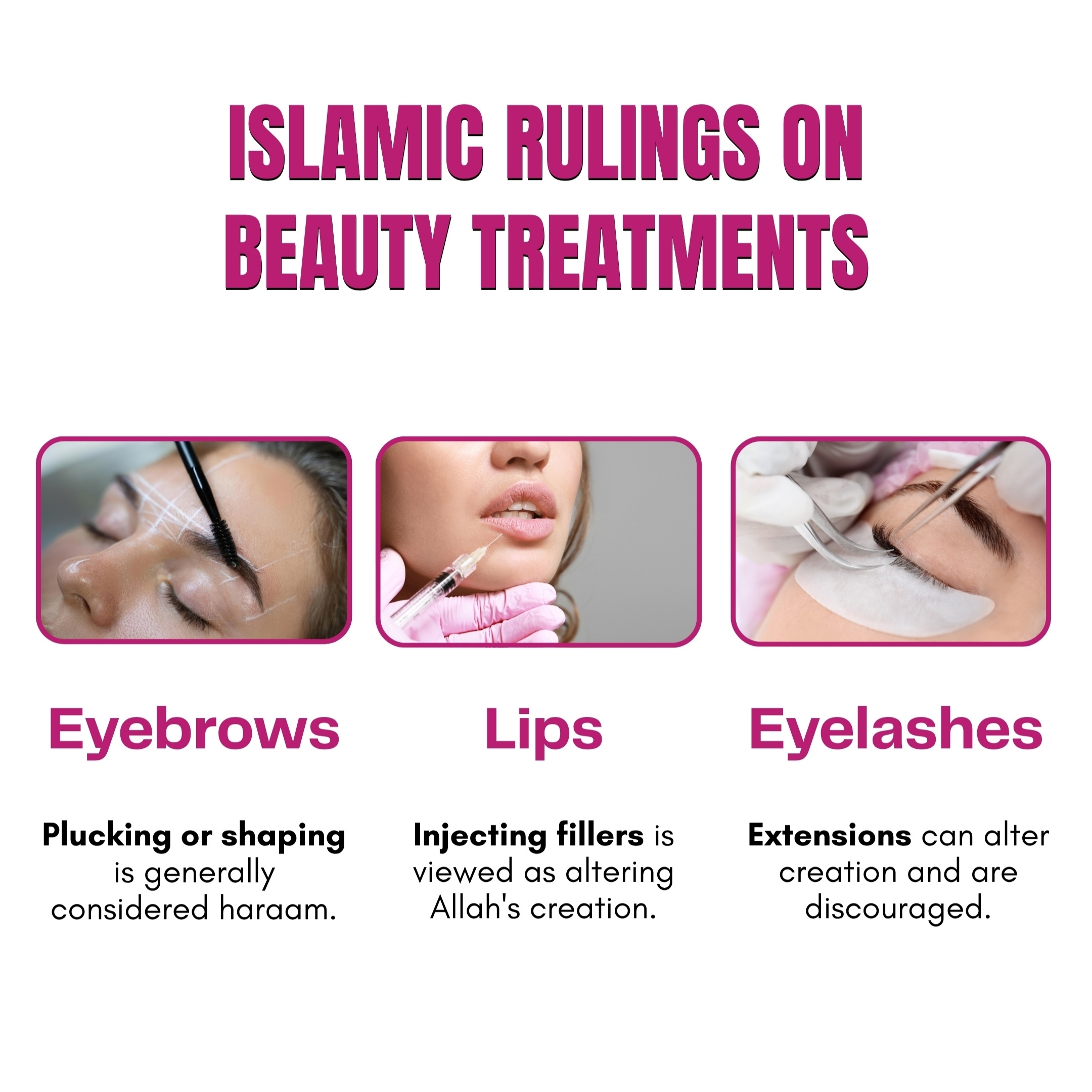
1. EYEBROW SHAPING — WHAT THE PROPHET ﷺ SAID DIRECTLY:
This is perhaps the most explicitly addressed aesthetic practice in the entire Sunnah.
The Prophet Muhammad ﷺ said:
"Allah ﷻ has cursed the woman who does tattoos and the one who has them done, the woman who plucks eyebrows (al-namisah) and the one who has them plucked, and the one who files her teeth for the purpose of beautification, changing the creation of Allah." — Sahih al-Bukhari, 5931 | Sahih Muslim, 2125
This hadith is sahih — authentically graded by both Imam Bukhari and Imam Muslim, the two most trusted hadith collections in Islamic scholarship. The language is unambiguous. The Prophet ﷺ did not say "it is disliked" or "try to avoid it." The word used is la'ana - cursed. This is one of the strongest warnings in Islamic law.
WHAT DOES AL-NAMISAH MEAN?
Al-Namisah refers specifically to the plucking or removal of eyebrow hair to reshape, thin, or alter the natural arch. This is the practice whether done with tweezers, threading used to change the shape, or waxing - of removing hair to redesign the brow beyond what Allah ﷻ naturally gave a person.
WHAT ABOUT THREADING FOR HYGIENE OR STRAY HAIRS?
Scholars who have studied this hadith carefully including Sheikh Ibn Baz (Rahimahullah) and Sheikh Ibn Uthaymeen (Rahimahullah) have stated that removing a few stray hairs that cause genuine discomfort or obscure the face is a matter of scholarly discussion, but the deliberate reshaping and thinning of eyebrows for aesthetic enhancement is what the hadith clearly prohibits. The intent and the degree of change matter enormously.
The honest conclusion: fashioning your brows into a trending shape whether that is a sharp arch, an ultra-thin line, or a bold Instagram brow — falls under what this hadith warns against.
2. EYELASH EXTENSION — ARTIFICIAL ADDITION OF THE BODY
Eyelash extensions involve attaching synthetic or natural hair fibres to the existing lashes to create length, volume, and dramatic effect.
The Prophet Muhammad ﷺ said:
"Allah has cursed the woman who adds hair extensions and the one who requests them." — Sahih al-Bukhari, 5933 | Sahih Muslim, 2122
This hadith refers to al-wasilah — the one who adds or joins false hair to the natural hair of a person. The scholars have extended this ruling to artificial lash extensions because the principle is identical: attaching foreign hair or hair-like material to the body to create a false impression of what Allah gave you naturally.
Sheikh Salih al-Fawzan, a respected contemporary scholar, has stated that eyelash extensions fall under the same prohibition as hair extensions because the illah (the reason for the ruling) is the same - deception through artificial alteration of the body's appearance.
WHY DOES THIS MATTER PRACTICALLY?
Beyond the Islamic ruling, lash extensions carry real physical risks, allergic reactions to adhesives, damage to natural lashes, and eye infections are well documented in clinical literature. The halal choice here also happens to be the healthier one.
3. LIP FILLERS — PERMANENT AND SEMI-PERMANENT ALTERATION
Lip fillers involve injecting substances most commonly hyaluronic acid into the lips to increase their volume, alter their shape, or enhance their symmetry.
There is no single hadith that names lip fillers specifically, this is a modern procedure. However, Islamic jurisprudence has a well-established principle:
"Every matter is judged by its objective." — Hadith of Umar ibn al-Khattab RA | Sahih al-Bukhari, 1
When scholars apply Quranic and hadith principles to modern procedures, they look at three things: the purpose, the permanence, and the harm. Lip fillers, when performed purely for cosmetic enhancement to change what Allah gave you — fall under the principle of Surah An-Nisa 4:119 (changing the creation of Allah) and the broader hadith warnings around altering the body for vanity.
Sheikh Assim al-Hakeem, a widely followed contemporary scholar, has stated clearly that cosmetic fillers intended purely for beautification and altering natural features are not permissible in Islam.
THE EXCEPTION:
If a procedure is medically necessary for example, correcting a genuine physical deformity that causes psychological or functional harm — Islamic scholars have generally allowed it under the principle of darurah (necessity). Cosmetic enhancement out of trend or dissatisfaction is not darurah.
A WORD TO THE SISTERS AND BROTHERS — READING THIS
We understand this is not easy to read, especially if these are treatments you have had or were considering. Please know this blog comes from a place of love, not judgement.
Allah ﷻ created you in the most perfect form He chose for you.
The Quran says:
"We have certainly created the human being in the best of moulds." — Surah At-Tin, 95:4
That is not a platitude. That is Allah ﷻ speaking about you, personally. The pressure you feel to look a certain way that pressure does not come from your deen. It comes from an industry worth billions of pounds that profits from making you feel inadequate.
You are not inadequate. You never were!
SEEK KNOWLEDGE. MAKE INFORMED CHOICES.
Islam does not ask us to be uninformed. It asks us to seek knowledge and then act accordingly, with sincerity and with the understanding that Allah ﷻ is Al-Ghafur, the Most Forgiving, for those who turn back to Him with genuine intent.
If you have questions about what treatments are permissible, what alternatives exist, or simply want to speak to someone who understands both the clinical and Islamic perspective, we are here.
اللَّهُمَّ أَرِنَا الْحَقَّ حَقًّا وَارْزُقْنَا اتِّبَاعَهُ، وَأَرِنَا الْبَاطِلَ بَاطِلًا وَارْزُقْنَا اجْتِنَابَهُ
“O Allah, show us the truth as truth and grant us the ability to follow it, and show us falsehood as falsehood and grant us the ability to avoid it.” — Recorded by Ibn Kathir in his tafsir; attributed to the du'a of the early Muslims
Disclaimer:
This blog is intended for educational purposes based on Quranic Ayat and authenticated hadith. We encourage readers to consult with a knowledgeable Islamic scholar for personal guidance on matters of Fiqh.
Visit Us at Dar Ul Shifa Health Clinic
We offer a range of clinically proven, health and wellness treatments for women and men in Oldham. Book a consultation today because your wellbeing, inside and out, matters.
YOUR HEALTH. YOUR FAITH. YOUR CHOICE, MADE WITH KNOWLEDGE.
Published by Dar Ul Shifa Health Clinic | Oldham
📍287 Rochdale Road, Oldham - OL1 2HG Uploading image……